
Player-owned progression
Your assets carry their history
A PULSE asset is more than its name or image. Its level, condition, progress and active state determine how it performs—and what the next owner receives.
The Player Marketplace makes that value visible. Eligible Shoes, Pods, Items and Shoe Boxes can be listed by their owners and purchased by other players in SOL.
What can move between players
Four market categories
Only market-eligible assets can be transferred. Anything earned or purchased with an account-bound rule remains attached to that account.
Type, rarity, level, attributes, Forge history and condition all stay with the Shoe.
Level, Watts gauge, production value and pity progress travel together. Nothing resets.
Tradable Items obtained from Sport Bags may enter the Market. Store-only Items remain account-bound.
Eligible Shoe Boxes may be traded unopened. A Starter Pack Shoe Box can never be listed.
A readable market
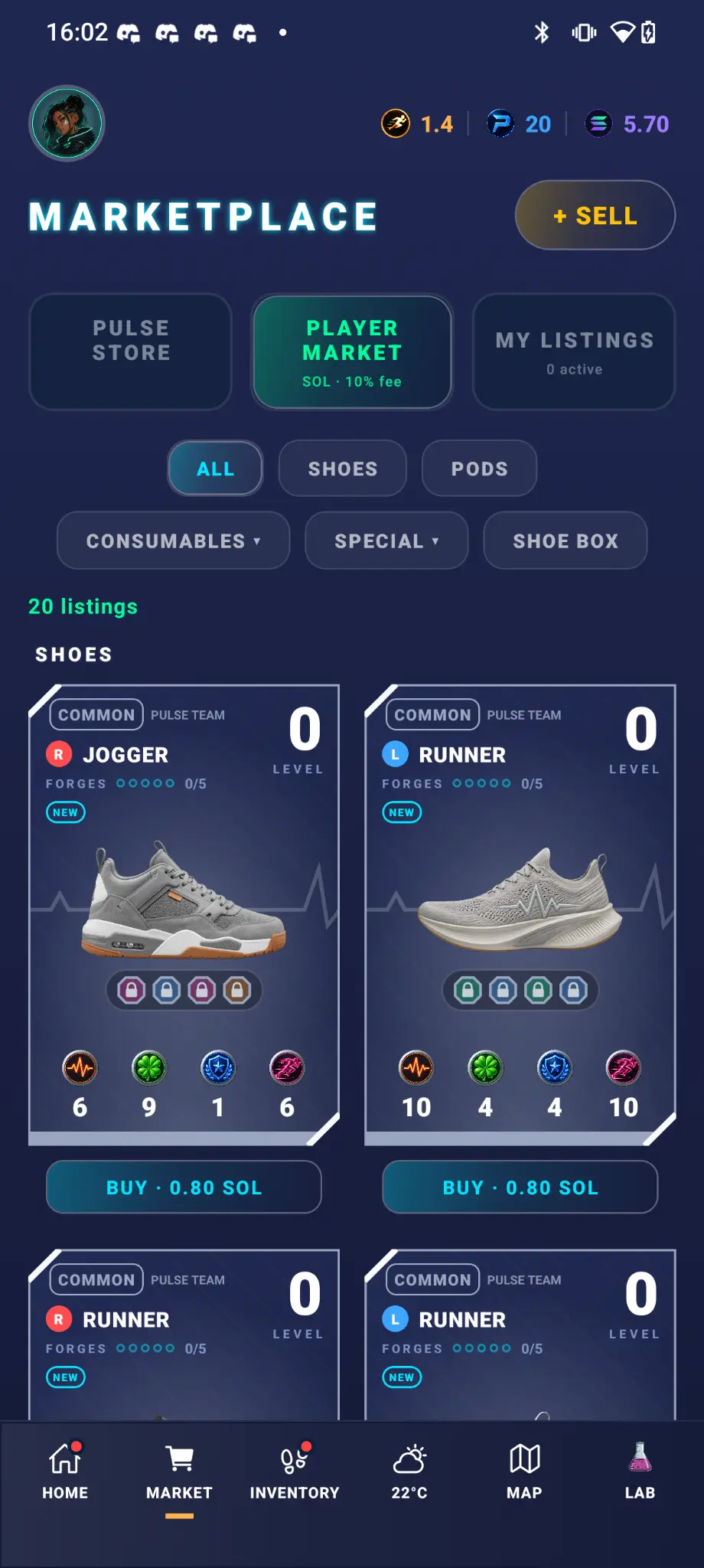
Compare the asset—not only the price
Market filters help players narrow listings by category, type and state. Each card exposes the information that matters before a decision is made.
Minimum listing price: 0.01 SOL
State follows ownership
What you see is what transfers
Buying a developed asset does not create a clean copy. The exact listed instance changes hands, including the progress already built into it.
Before a listing
The asset must be ready to leave
Listing rules protect the current state of the game. An asset cannot be sold while another system is still using or changing it.
Fully repaired, not injured, not leveling, no Pod inserted and no active Forge or Starter Pack lock.
The Pod must be out of every Shoe and its removal cooldown must have ended.
The Item must come from an eligible source and the listed quantity must be available.
The box must not belong to a Starter Pack and must remain unopened.
While listed
Market assets are frozen
A listed asset remains visible to its owner, but cannot be changed until the listing is cancelled or completed. This guarantees that the buyer receives the state shown on the Market.
Read the state before the price
Marketplace states at a glance
A Pod with no Watts invested and no training history.
A Pod carrying Watts toward its next training level.
Previous unsuccessful Training attempts improve the next success chance.
The Pod’s definitive production value has been established.
The asset cannot be used or modified while its Market listing is active.
A recently removed Pod must complete its waiting period first.
The asset remains attached to the account that received or purchased it.
The exact asset instance may move between players through the Marketplace.
From listing to settlement
One clear exchange
The seller selects an eligible asset and sets its SOL price.
Buyers compare listings, states and prices through the Market.
The selected asset moves to the buyer as one complete transaction.
The seller receives the sale price minus the Marketplace fee.
Marketplace fee · 10%
0.10 SOLSeller receives
0.90 SOLA 10% seller fee
Every completed sale supports PULSE
The Marketplace deducts a 10% fee from the seller when a purchase is completed. The buyer pays the displayed listing price; no fee is taken for creating or cancelling a listing.
Part of every Market fee is set aside for a future layer of the PULSE ecosystem. Its purpose will become clearer beyond the gates of Merit.
Two different counters
Store access is not Market ownership
Cards and selected Items are purchased with PRIME and remain bound to the player’s account.
Eligible owned assets are listed by players, purchased by players and settled in SOL.
Keep · develop · trade
Ownership creates another decision
The strongest asset is not automatically the one to sell, and the cheapest listing is not automatically the best buy. Condition, progress, compatibility and future plans all shape its real value to a player.